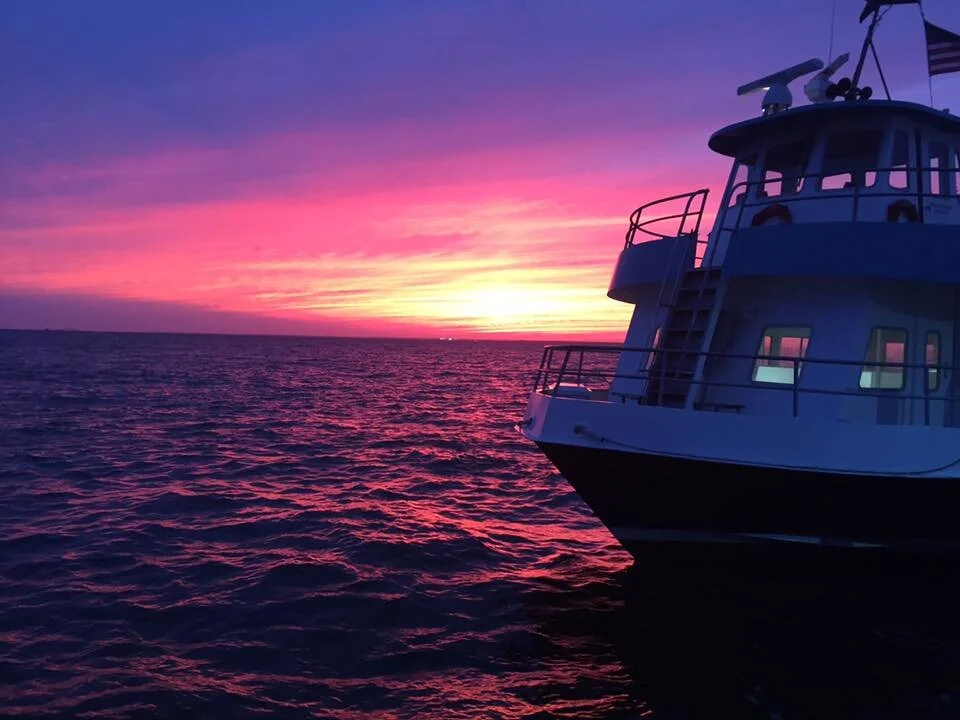
You get on a ferry and the world drifts away
The change is palpable
It’s about the journey and the destination
Sayville Ferry Service has been making this magic happen for years
Sayville Ferry (est. 1894)
By Robert Bonanno. Updated February 2026.
Sayville Ferry Services (SFS) has been virtually existential to Fire Island Pines since its inception. Across multiple generations of ownership by the Stein family, it has been central to the community’s operation and development. Today, it is an integral part of Pines’ social and civic fabric.
The story of Sayville Ferry actually pre-dates the Pines. It begins just before the start of the 20th Century with an immigrant named Karl and a boat named Mildred H.

Karl and Mildred H
Charles Karl Stein (Karl) was 15 years old when he hopped a freighter ship from Europe headed to New York City. He ended up in the Dutch-speaking community of West Sayville, where he married the daughter of a prominent family in town. When he was discouraged from going into the family business with his brother-in-laws, he started a mechanic shop in West Sayville. In those days, the only way to get to Fire Island was to hire a sailboat. There were no organized communities, just squatters and day trippers. Karl always loved sailing boats and in 1894 he started ferrying people to the barrier beach on weekends as a hobby and a way to make extra money.
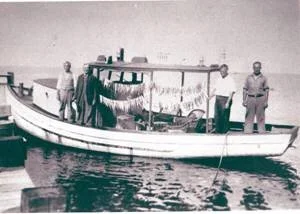
Karl’s initial service was carrying parties to either Cherry Grove or Water Island in his gaff-rigged sloop, Mildred H., which had been built at Oak Island in 1894. It was equipped with a “shoving pole” in case the wind gave out. Round trip fare was ten cents with a bowl of chowder and a cracker thrown in. The boat landed wherever the most passengers wanted to go, be it for picnics, gathering holly, or just for a day’s outing. In 1918, he upgraded by acquiring another sloop, the Dare, that he had converted to motor power.
The Dare. Photo courtesy of the Stein Family.
What Karl likely didn’t know then was that he wasn’t just starting a ferry service. He was laying the foundation of a five-generation (and counting) legacy that would shape the character of Long Island’s South Shore and make an indelible impact on generations of people, passengers and crew alike.
When Karl’s son, Frederick—better known as Fred—took the helm in the 1920s, he brought innovation with him. He motorized his father’s sailboat and began running scheduled trips, charging 40 cents for a round-trip ticket.
In November 1933 Fred purchased the former pleasure yacht Wayfarer from Barnegat, NJ. Built in 1928, it was 51 feet long with a 100 horsepower motor and a capability of 12 miles an hour. Unfortunately, Wayfarer I was unsuitable to work as Fire Island ferry. Its keel was too deep for the Great South Bay and it became known as the “See Saw” ferry as passengers had to move en masse from stem to stern to effect proper trim. As a result, Fred sold it and designed a boat specifically for his business, Wayfarer II, to be built by Samuel Newey in his yard in Brookhaven.
Wayfarer
Wayfarer II
1938. The Hurricane…

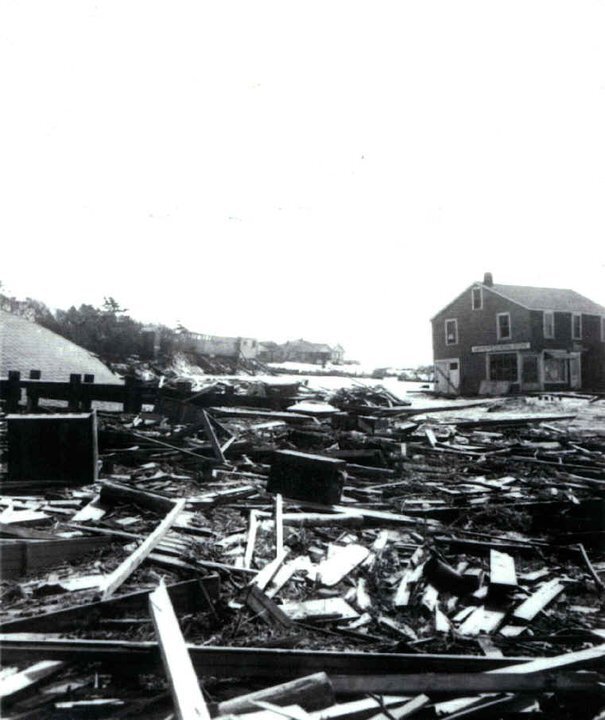
Fred’s timing was unlucky. The Wayfarer II entered service the summer of 1938 just before a September hurricane laid waste to Cherry Grove and devastated tourist business. As a result, the Wayfarer II was sold to the English to be a hospital ship in World War II; it was resold after the War to be a tourist craft at Holyhead, Wales and a book called “The Ghost Ship” was written about it. (It was still afloat in 1993 as the Queen of the Sea in 1994.)
Kenneth Stein Sr.

Fred’s son, Kenneth Sr., assumed control of the business in 1939, just as the world was bracing for war. It seemed an inopportune time, but World War II created an unexpected series of opportunities.
In 1939 Cherry Grove was a small and slow growing community. The effects of the 1938 hurricane were wearing off and people started to rebuild. Then in 1942 the attack on Pearl Harbor things changed. A blackout took over and residents were required to have no bright lights, no walking on the boardwalks with flashlights or cigarettes so as not to create a silhouette as nazi submarines were patrolling the area for ships. The army took over the hotel in the Grove and marines stayed at the Lone Hill Coast Guard Station in the now Pines. The beach was patrolled by jeep and every 15 minutes two army men left the hotel on foot heading east and west, followed 15 minutes later by two marines heading east to west. They would meet somewhere in the middle turn about face and return to their station on a 24 hour basis.


The Beachcombers
During the war and after, towns on Fire Island started to become organized and ferrying people there became a full-time business. Not only was there the military outpost, but servicemen and their families began to go out to the island for picnics and beach time. During this time Ken Sr. acquired three ferry boats Beachcomber I in 1940, Beachcomber II in 1944, and shortly after Beachcomber III. Beachcomber IV came later in 1956. These ferries started most of the routes that are still in place today.
The Birth of The Pines
In 1949 the owners of the Home Guardian Company of NY approached Ken Stein Sr. to start a ferry run to a new development they had on the drawing board to be called “Fire Island Pines.” It was to have a sheltered inland harbor, a hotel and casino, a grocery store, and a post office. The old Lone Hill Coast Guard Station was to be turned into a community house.

As with Cherry Grove, when the Pines were being built, Ken Stein Sr. helped bring the heavy equipment to Fire Island that cleared the way for boardwalks and houses. It was important work, and in recognition of his service, Home Guardian honored Ken Sr. by naming the last two walks in this new community after his daughters Sandy and Susan.

In 1953 Ken Sr. started to run the first daily scheduled ferry service between Sayville and Fire Island Pines. He reconverted a old rum runner that had run to Ocean Beach from Bayshore since the end of Prohibition. He installed new engines and named her Fire Island Pines.
Fire Island Pines. Photo courtesy of Sayville Ferry.

Fire Island Pines carried 54 passengers and crossed in forty minutes.

In 1956 Ken Sr. bought a former PT craft Beachcomber IV, and converted it into a ferry. He was able to knock off 10 minutes on the 40 minute ride. He used this ferry to service the more developed Cherry Grove. He moved Beachcombers I and II to service the Pines and sold the Fire Island Pines.
The 1960s saw rapid growth as both Cherry Grove and the Pines attracted people from New York City, Long Island and beyond. Both Beachcomber I and II were retired in 1962. Sayville Ferry Service continued to upgrade service to keep pace with demand, adding the famous Flying Hornet, which would serve until 1975.

Beachcomber I in Cherry Grove

Beachcomber IV arriving.

Beachcomber III in Sayville

The Flying Hornet leaving the Pines in 1965.

The growth of the ferry business reflected the strength of the post-war American economy that permitted more people to take vacations and some to even buy summer homes on Fire Island. This not only benefitted the ferry business, but also contributed greatly to other parts of the local economy.
Suffolk County News 1959

Cherry Grove in particular attracted a crowd from the arts and fashion world in New York City.
Cherry Grove Ferry 1951
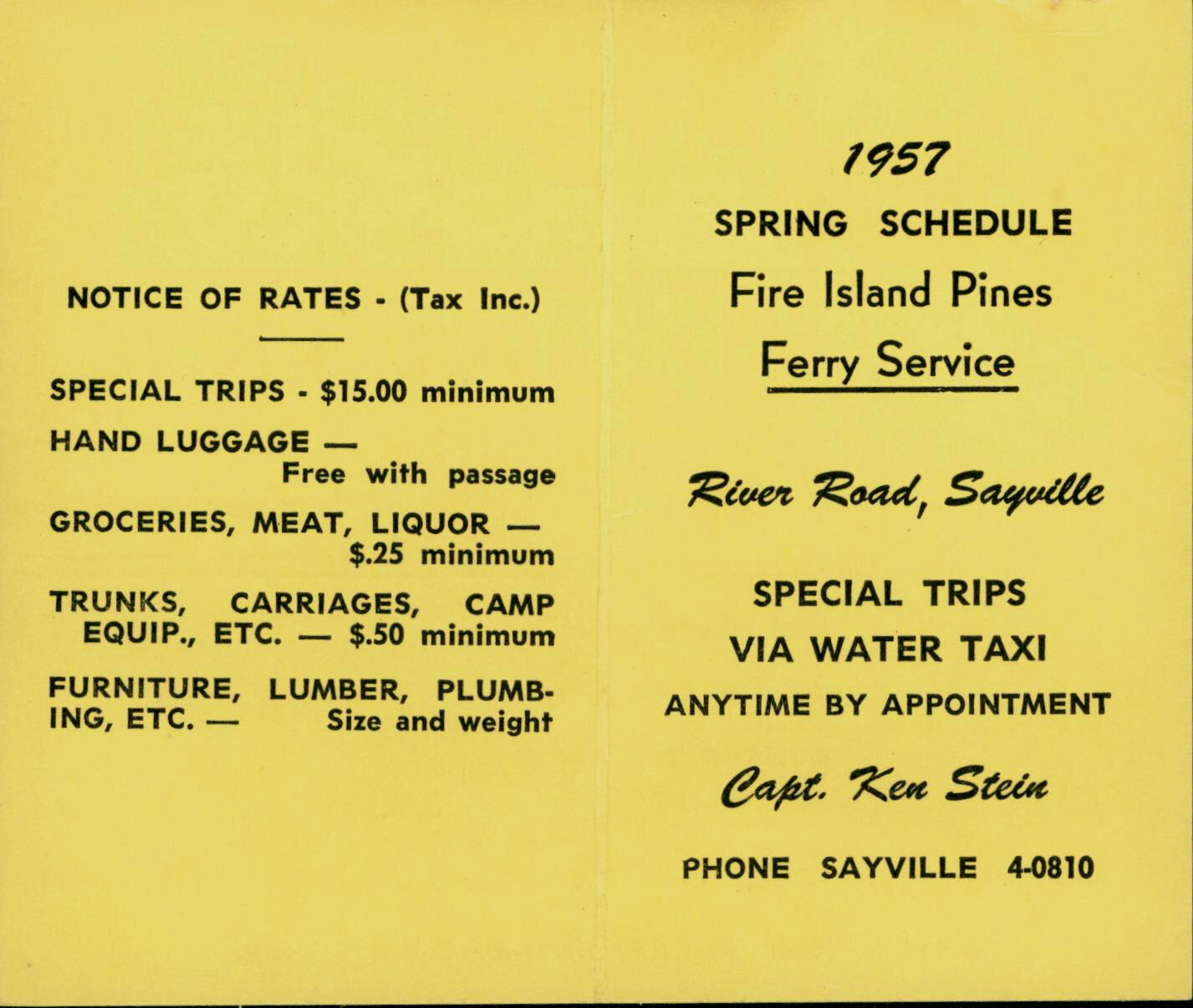
To accommodate the demand, not only were additions made to the regular summer schedule, but water taxi service continued to be made available.
The Apprentice
The next generation of Steins joined Sayville Ferry in the 1960s when Kenneth Jr.—simply Ken—entered the business as a teenager and apprenticed with his father. During this time Sayville Ferry Service modernized with faster, larger, and more durable vessels. They introduced the Fire Island Empress in 1963 and then the Fire Island Duchess in 1966. It represented a major step forward in Fire Island transportation, in keeping with the rising incomes and tastes of its visitors and residents.
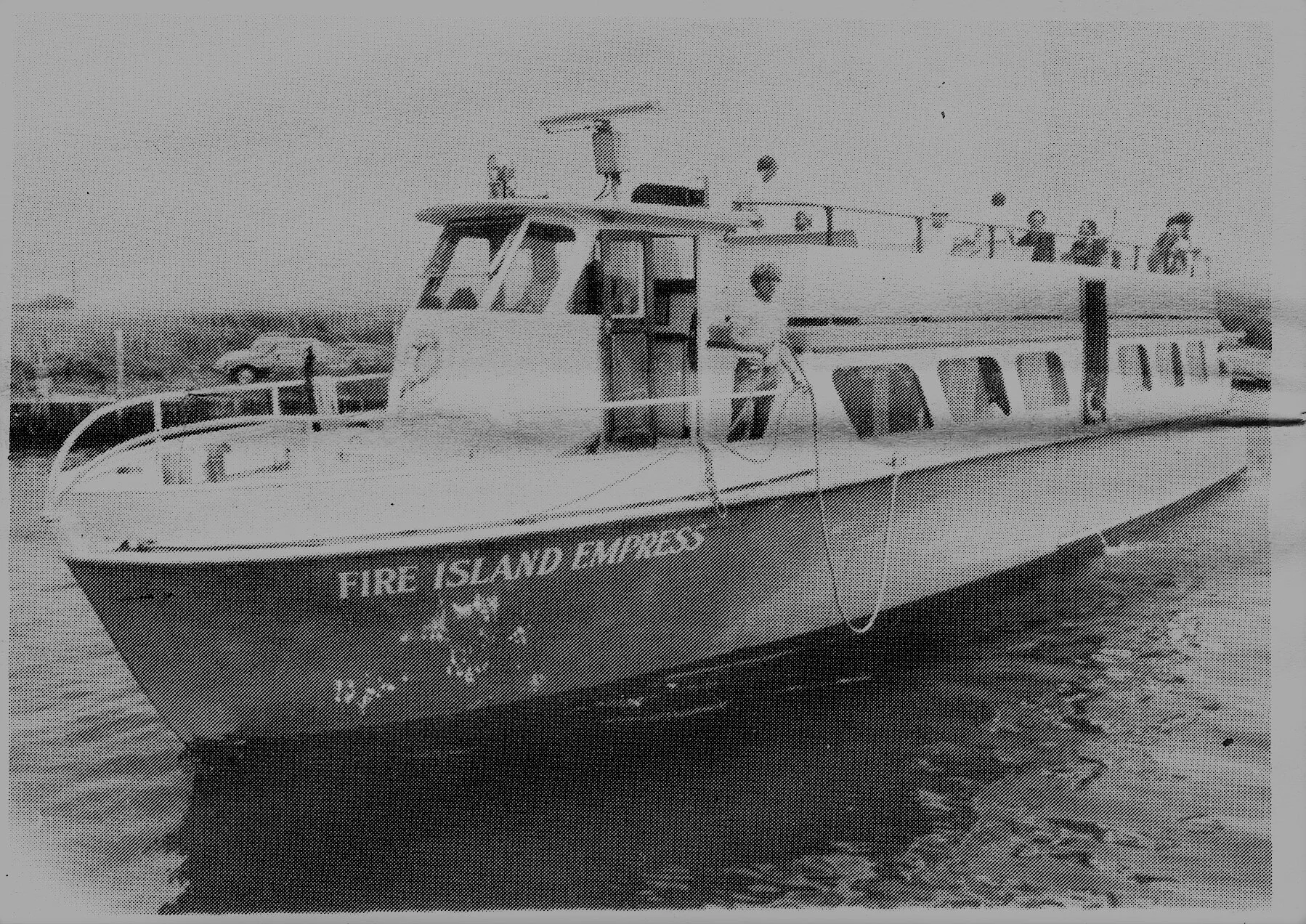
The Fire Island Empress arriving in Sayville.
Circ 1966. Photo courtesy of Sayville Ferry Services

Fire Island Empress Departing the Pines.
Circa 1970. Photo courtesy of Sayville Ferry Services.
The Fire Island Empress was not only larger, but provided a more comfortable and elegant than its predecessors.

Fire Island Empress circa 1970.

The Fire Island Duchess
Circa 1966
A New Era

In 1979, Ken Stein Jr. took over running the Sayville Ferry Service from his father.
Fire Island Duchess in the Pines in 1979

Ken Jr. represented the fourth generation Stein to lead the company, an extremely rare occurrence in modern day America. It reflected the culture of stewardship embedded in the family and their commitment to the communities they served.
Fire Island Duchess crew in 1979
In keeping with his family’s tradition of advancement and innovation, under Ken Jr.’s stewardship, Sayville Ferry Service modernized with faster, larger, and more durable vessels, including the Fire Island Clipper in 1980, a sleek aluminum ferry carrying more than 340 passengers.
During his tenure, the Pines and Cherry Grove underwent a series of major cultural changes. Both became more openly gay, and the Pines in particular became much more glamorous, attracting stars from the film, stage and music worlds. It also saw the advent (and subsequent demise) of the seaplane services.
The biggest change came in the 1980s when the AIDS pandemic ripped through both communities. Initially, it was centered in the gay community and its cause and modes of transmission were unknown. The epidemic resulted a period of fear and anger directed at gay people, fanned by waves of misinformation. Despite this, Ken Jr. skillfully managed his organization and staff and continued to serve both Cherry Grove and the Pines faithfully.


Ken Jr. also professionalized the operation, ensuring remained it compliant with evolving maritime regulations. By this point, Sayville Ferry operated as a regulated monopoly. Passenger operations were licensed by the U.S. Coast Guard; oversight was provided by the New York State Department of Transportation and other agencies, covering nearly every aspect of their business, including routes, fares and safety standards. Management was required to recruit and train staff according to the specific standards, certify vessels and crews, conduct safety drills for emergencies like fire or man overboard, and file compliance reports. Oversight bodies conducted regular inspections to ensure standards are met. Even modest ticket price adjustments required state approval, making financial planning a careful balancing act. It was a far cry from Karl’s early operations with the Mildred H.
Ken III - or Just Ken
Sadly, Ken Jr. passed from cancer in 2000 at the age of 57. Today, the helm belongs to his son Kenneth Stein III, also known as Ken, who began working the docks at age 14. When it comes to running a ferry service, Ken has done it all: scrubbing decks, loading freight, piloting ferries, and managing the company.
Like his forefathers, Ken has continued to lead Sayville Ferries to new heights. He introduced new vessels, including the Cross Bay Clipper in 2014 and acquired Coastline Freight that same year, adding a heavy duty freight service to the company’s services. To support that business, he added the Fire Island Seahorse in 2018. It represented a continuation of the Stein strategy to continually enhance vessels and services to meet the demands of the communities they serve.

The Cross Bay Clipper joins the fleet in 2014

The Fire Island Seahorse Freight in 2018.
Today Sayville Ferry Services serves a diverse set of customers, including homeowners, renters, day trippers, contractors, retailers, the U.S. Postal Service, and volunteer fire departments. Demand is seasonal, subject to weather, and influenced by cultural shifts; in recent years, for instance, Thursday has become the new Friday for summer weekend getaways.
Ken has continued to keep Sayville Ferry as part of the fabric of the communities it serves. They are major supporters of the Fire Island Dance Festival and the Pines Party, and Ken himself drives the ferry carrying the drag queens on July 4th’s Annual Invasion of the Pines.
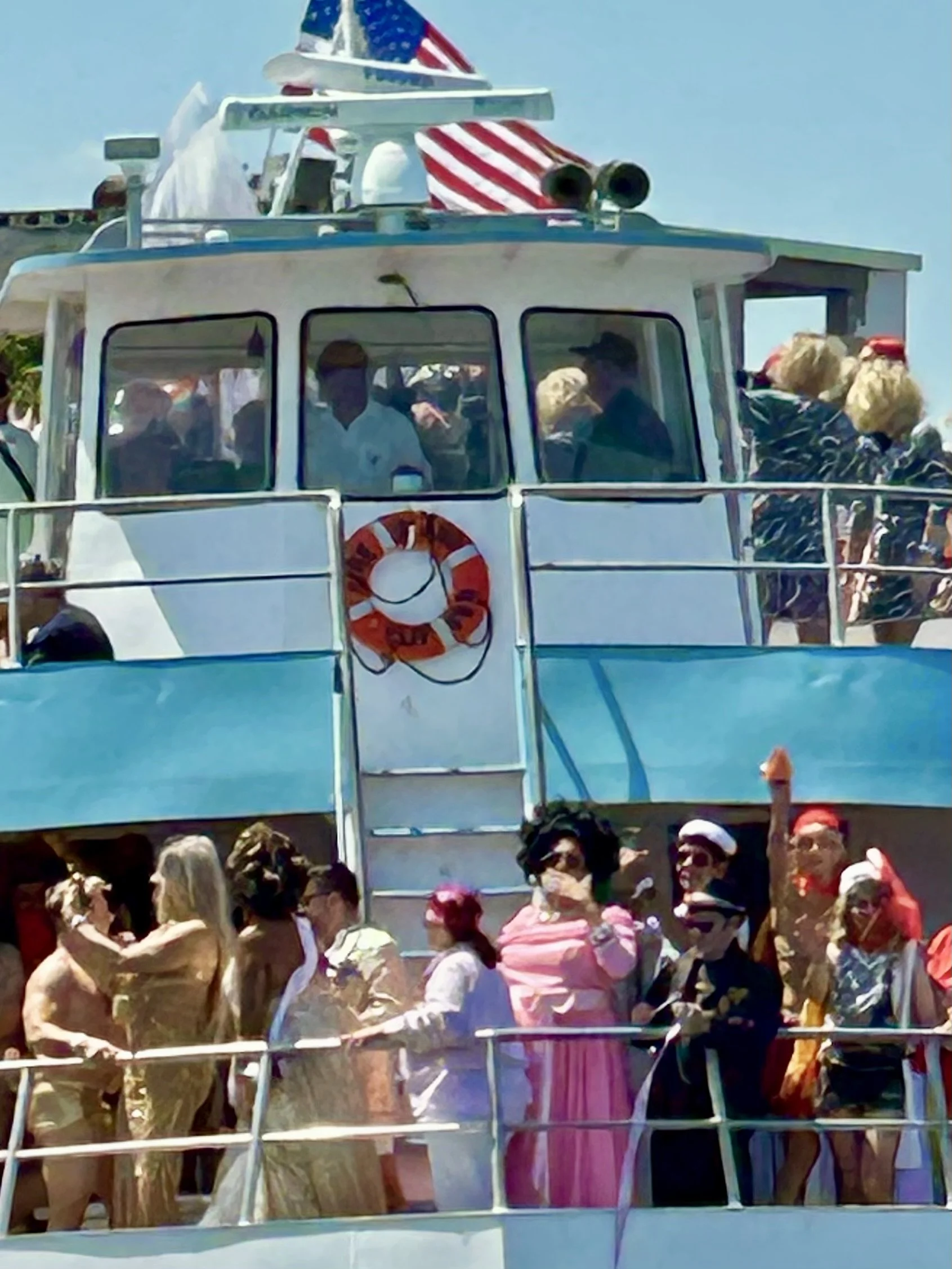
Invasion 2025 with Ken Stein III piloting the Fire Island PANZI (a temporarily renamed ferry in honor of the original organizer and invader Panzi).
One of the great accomplishments of the Stein family is despite the highly regulated nature of the business, Sayville Ferry Service has maintained the feel and culture of a family business. One of its defining features is the longevity of its staff. Many began as teenage deckhands, staying for decades, and rising through different jobs like customer service, freight, maintenance, and piloting. Two are Joe Lawrence and Tim Leigh-Manual. They have worked at Sayville Ferry in some form or another for more than three decades and neither have plans to leave. As Joe says: “Sayville Ferry is a great place to work. It’s literally like a family. People have each other’s backs, and we trust each other.”
Tim adds: “It is a great place for young people to get their first experience working. They learn important skills, and they get to be out on the water during the summer.”
As two straight men who grew up serving the primarily gay communities of the Pines and Cherry Grove their reflections are both heartening and emblematic of the ferry service crew: “The Pines and Grove communities, while very different, are absolutely the best and a pleasure to serve.”
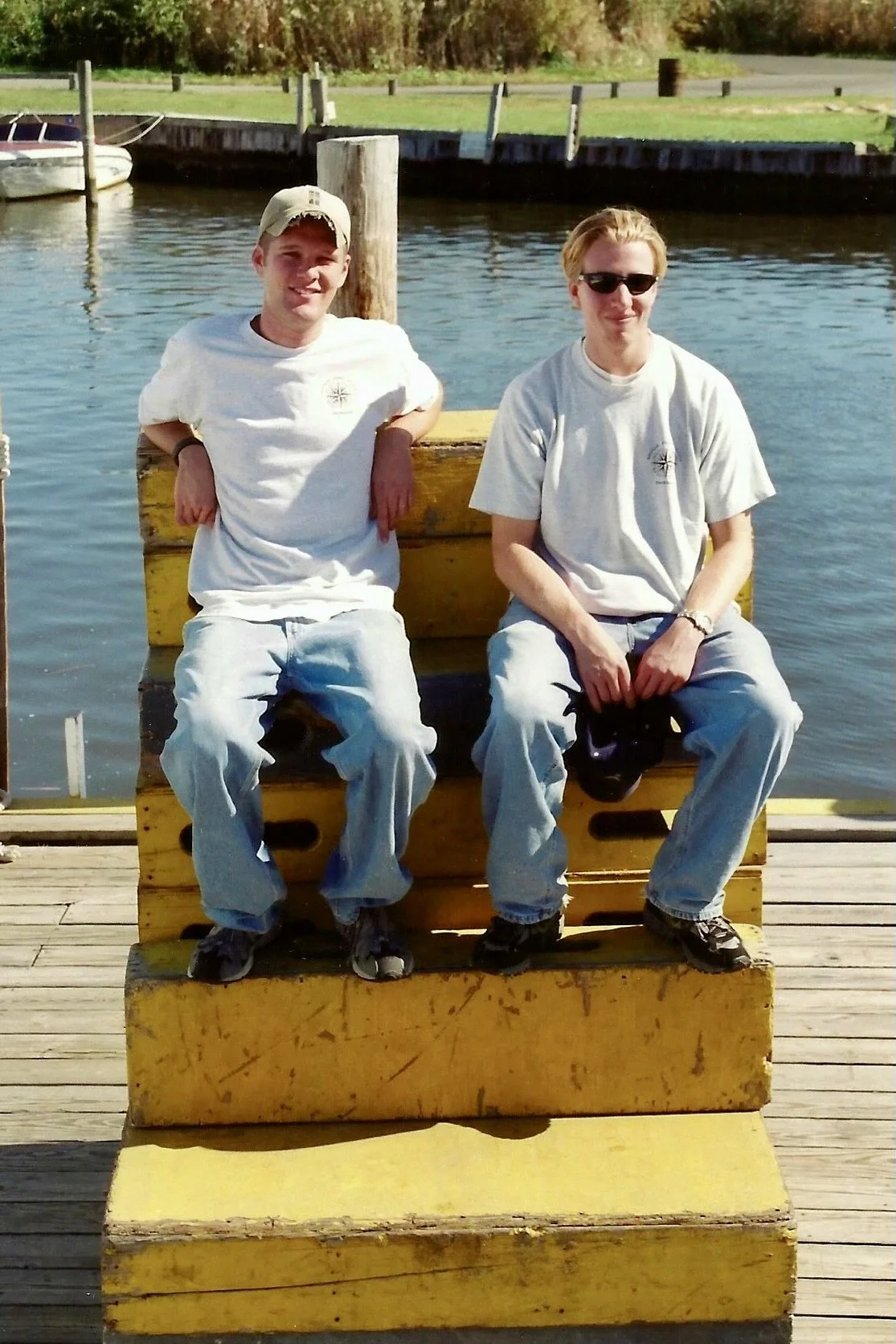
A young Tim Leigh-Manual (right) and Joe Lawrence (left).
The relationship between Sayville Ferry Service and the Fire Island communities it serves is akin to a marriage. In good times and bad, they are bound together; divorce would be both complicated and costly for all involved. Negotiations over fares, which are regulated by Suffolk County, ferry schedules, and Sayville Ferry’s lease for use of FIPPOA’s harbor property have occasionally been contentious, sometimes intensely so. Yet even at its most strained, no one in the Pines has ever regarded the Sayville Ferry as anything less than essential.
The reasons for these tensions are often varied and sometimes murky. As Fire Island Property Owners Association (FIPPOA) President Henry Robin has observed, the interests of the communities and the ferry service have not always aligned. Despite this, they have consistently managed to find common ground on major issues, from adding services to coordinating schedules with the Long Island Railroad. As he put it:
“Ken and his family care deeply about the Pines and the other communities they serve. I regularly seek out his opinion on matters, and we are comfortable discussing even the most difficult topics. While I’m sure there will be issues of contention in the future, as long as we maintain the chemistry and trust we have fostered, I have no doubt we will resolve them.”
It should be recognized that Sayville Ferry’s commitment extends far beyond routine passenger transport. The Pines and Cherry Grove are communities that they helped build. They are a part of Sayville Ferry’s legacy and identity, and they go to great lengths to support them. Beyond their support for cultural activities, they have been a key player in their security. Fire is among the greatest threats to Fire Island communities and Sayville Ferry has long been the first responder’s bridge. At all hours of the day or night, the company has transported firefighters into communities in crisis and returned them once the danger was under control. This service -- provided without charge -- has protected countless lives and homes. As Fire Chief Jordan Cohen of the Fire Island Pines Fire Department says:
“The Sayville Ferry provides an invaluable service in helping us protect the community. As a small fire department we depend on aid from the mainland and other communities. The ferry service’s prompt response to any outbreak at any hour, day or night, has played a huge role in containing the damage from outbreaks.”
Ken is fully aware and proud of the Stein legacy. For him running Sayville Ferry Service and now Coastline Freight is so much than logistics, timetables and tide charts. Every ferry that departs Sayville carries not only travelers and freight but also the enduring spirit of a family who has given their lives to the water. As Ken III said in Crayton Robey’s acclaimed documentary, Where Ocean Meets Sky:
“It’s community building and continuity. I know I’m standing in the footprints of my father and grandfather and so I do my part to help the communities we serve thrive.”
For over a century, the Stein family has been defined by resilience, stewardship, and an unshakable dedication to community. Born of sailcloth and salt air, their legacy has been both a literal and symbolic bridge, linking people to place, and the mainland to Fire Island. Across generations, through wars, storms, good times and bad, the Steins have held their course steady. Their commitment has helped build an extended family among their crew, and helped communities like the Pines and Cherry Grove flourish and be places where people are free to be their authentic selves.
A Photo Tribute to The Stein Family